

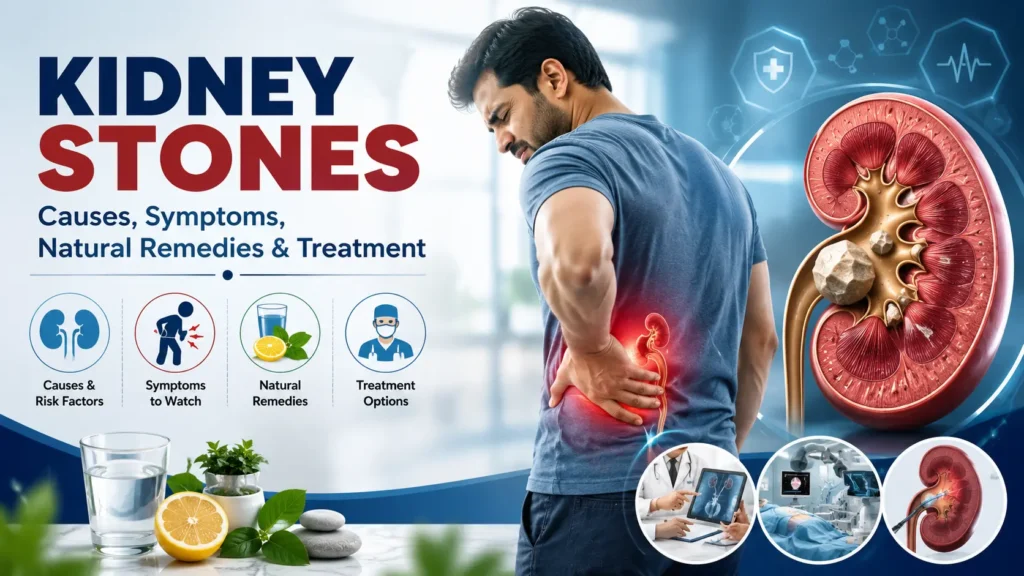
The Complete Guide to Kidney Stones in India
Causes, Natural Remedies, Medical Treatment, Prevention, Research Data & Insurance Coverage
Table of Contents
Introduction
A sudden, sharp pain in the side or back that comes in waves, sometimes radiating toward the lower abdomen — for many people in India, this is how they first learn they have a kidney stone. It’s one of the most common urological conditions in the country, and also one of the most preventable, once you understand what’s actually driving it.
Kidney stones aren’t just an uncomfortable inconvenience. Left unmanaged, they can lead to recurring episodes, urinary tract infections, and in severe cases, kidney damage. Yet the condition responds remarkably well to the right combination of hydration, diet, and, when needed, medical intervention.
This guide covers everything from what a kidney stone actually is and why it forms, through natural remedies and medical treatment options, prevention and lifestyle changes, a research-backed look at how common the condition is across India, and — because treatment costs are a real concern for most families — a breakdown of how Indian health insurance policies typically handle kidney stone claims.
| Key Takeaways |
- Kidney stones affect an estimated 12% of India’s population, with certain states forming a recognized “stone belt” due to climate and dietary patterns.
- Low fluid intake and high-oxalate, high-sodium diets are the leading modifiable causes, alongside genetic and regional factors.
- Small stones often pass naturally with hydration and pain management; larger stones typically require procedures like lithotripsy or ureteroscopy.
- Natural remedies can support prevention and comfort but should complement — not replace — proper medical evaluation, especially for larger or recurring stones.
- Most Indian health insurance policies cover kidney stone treatment as a day-care procedure, but waiting periods and pre-existing disease clauses vary significantly by insurer.
- Recurrence is common — roughly half of people who form one stone will form another within several years without preventive lifestyle changes.
1. What Is a Kidney Stone?
A kidney stone (renal calculus) is a hard, crystalline mass that forms when certain minerals and salts in urine — such as calcium, oxalate, or uric acid — become concentrated enough to crystallize instead of staying dissolved.
Stones can range from a grain of sand to a golf ball in size. Small stones often pass through the urinary tract without much notice; larger ones can block urine flow, causing the intense pain most commonly associated with the condition, and in some cases require medical intervention to remove.
2. Types of Kidney Stones
Not all kidney stones form for the same reason, and the type often points toward a specific underlying cause worth addressing:
| Stone Type | How Common It Is | Main Cause |
| Calcium Oxalate | Most common type worldwide and in India | Low fluid intake, high-oxalate diet, low calcium intake |
| Uric Acid | More common in southern India and in people with gout or high-protein diets | Dehydration, high animal protein intake, obesity |
| Struvite | Linked to recurrent urinary tract infections | Chronic or repeated UTIs, more common in women |
| Cystine | Rare, caused by a genetic condition | Inherited disorder affecting amino acid reabsorption |
Research on stone composition across India has found regional variation — mixed and calcium oxalate stones are more common in northern and coastal regions, while uric acid stones appear more frequently in southern states, likely reflecting differences in diet and climate.
3. Why Kidney Stones Happen
Kidney stones form from a combination of factors, most of which fall into a few well-established categories:
- Low fluid intake: Concentrated urine gives minerals more opportunity to crystallize — this is consistently the single largest modifiable risk factor in Indian studies
- Diet: High sodium, high oxalate foods (spinach, nuts, certain lentils in excess), and high animal protein intake all raise risk
- Climate: Hot climates increase fluid loss through sweat, concentrating urine further — a major reason certain Indian states see higher rates
- Body weight: Obesity and metabolic syndrome are linked to higher stone risk, partly through effects on urine composition
- Family history: A family history of stones raises individual risk, though research suggests shared diet and environment often play as large a role as genetics
- Underlying conditions: Gout, urinary tract infections, and certain metabolic or digestive conditions can all increase stone risk
4. Kidney Stones in India: A Research Snapshot
India carries a notably high burden of kidney stone disease, with research consistently placing national prevalence at around 12% of the population — in line with the global average, but concentrated more heavily in certain regions.
- An estimated two million people in India are affected by kidney stone disease each year, according to clinical research
- Gujarat, Maharashtra, Rajasthan, Delhi, Haryana, Punjab, and parts of the North Eastern states are recognized as India’s “stone belt,” linked to hot climates and oxalate-rich diets
- Hospital-based studies report lifetime prevalence estimates ranging from roughly 8% to 12%, with notable regional variation between northern and southern India
- Men are diagnosed more frequently than women across most Indian studies, though the gap has been narrowing in recent research
- Recurrence is significant: research shows roughly 10% of patients form another stone within a year, rising to about 50% by the ten-year mark without preventive changes
- Studies consistently link low fluid intake, dehydration, and mixed or high-sodium diets as the strongest modifiable risk factors identified in Indian patient populations
This regional concentration is a big part of why prevention — specifically hydration and diet — carries outsized importance for people living in India’s hotter, drier states.
5. Symptoms You Shouldn’t Ignore
- Severe, wave-like pain in the back or side, below the ribs, that may radiate to the lower abdomen or groin
- Pain or a burning sensation during urination
- Pink, red, or brown-tinged urine (blood in the urine)
- Cloudy or foul-smelling urine
- Nausea and vomiting accompanying the pain
- Fever and chills, which can indicate an accompanying infection and warrant urgent care
| When to Seek Urgent Care Severe pain combined with fever, chills, or difficulty urinating can indicate an infected, obstructed kidney — a medical emergency. Seek immediate care rather than waiting it out at home. |
6. Natural Remedies and Home Care
For small stones, especially those under about 5mm, natural approaches can support the body’s ability to pass a stone and reduce future risk — though they work best alongside medical guidance, not in place of it.
- Increase water intake significantly: Aim for enough fluid to keep urine pale yellow throughout the day — this is consistently the most effective natural measure
- Lemon and citrus intake: Citrate found in lemons may help prevent certain stones from forming, and many people find diluted lemon water a reasonable daily habit
- Coconut water: Traditionally used in India for urinary health, and reasonably hydrating, though it shouldn’t replace plain water as the primary fluid source
- Reduce salt intake: Lower sodium reduces calcium excretion in urine, directly lowering stone-forming potential
- Moderate oxalate-rich foods: Spinach, beetroot, and certain nuts can be enjoyed in moderation rather than eliminated entirely for most people
- Stay physically active: Movement supports overall urinary tract health, though it’s a supporting factor rather than a primary treatment
It’s worth being cautious about unverified supplement claims promising to “dissolve” stones quickly — while dietary support is genuinely useful, larger stones typically still require medical evaluation and, often, a procedure.
7. Medical Treatment Options
Watchful Waiting
For small stones (typically under 5mm), doctors often recommend increased fluids and pain management while monitoring for natural passage, which occurs in a majority of small stone cases.
Medication
Alpha-blockers are commonly prescribed to relax the ureter and ease stone passage. Pain relief and, in some cases, medication to manage specific stone types (like allopurinol for uric acid stones) may also be used.
Extracorporeal Shock Wave Lithotripsy (ESWL)
A non-invasive procedure using sound waves to break stones into smaller fragments that can pass more easily. It’s one of the most commonly used procedures for moderate-sized stones and is typically classified as a day-care procedure by Indian insurers.
Ureteroscopy
A thin scope is passed through the urinary tract to locate and remove or break up the stone, often using a laser. Also commonly performed as a day-care procedure.
Percutaneous Nephrolithotomy (PCNL)
Used for larger or more complex stones, this involves a small incision to remove the stone directly and typically requires a short hospital stay rather than day-care treatment.
8. How to Avoid Kidney Stones: Prevention Strategies
- Drink enough water to produce at least 2–2.5 liters of urine daily — in hot Indian climates, this often means significantly more fluid intake than standard international guidelines suggest
- Moderate sodium intake, being mindful of the high salt content common in packaged and restaurant food
- Maintain adequate (not excessive) dietary calcium, since very low calcium intake can actually increase oxalate absorption and stone risk
- Limit animal protein if you’ve had uric acid stones specifically, since it raises uric acid levels
- Manage body weight, since obesity is an independent risk factor identified across multiple Indian studies
- Get any recurrent urinary tract infections properly treated, since they’re linked to struvite stone formation
9. Lifestyle Changes for Long-Term Prevention
Beyond specific dietary tweaks, a few broader lifestyle shifts make a meaningful difference for long-term prevention, especially given how common recurrence is:
- Build a consistent hydration habit, such as keeping a water bottle visible throughout the workday rather than relying on thirst alone, which is an unreliable signal in hot climates
- Reduce reliance on packaged and restaurant food, which tends to carry significantly more sodium than home-cooked meals
- If you’ve had a stone before, ask your doctor about a metabolic workup to identify your specific stone type and tailor prevention accordingly, rather than following generic advice
- Schedule periodic check-ins, particularly in the first two years after a stone, since this is when recurrence risk is highest
Since roughly half of people who form a stone will form another within a decade, prevention is genuinely worth treating as an ongoing habit rather than a one-time fix after treatment.
10. Medical Insurance for Kidney Stones in India
Given the cost of procedures like lithotripsy or PCNL, understanding how Indian health insurance handles kidney stone claims matters as much as understanding the treatment itself. Here’s a summary of the clauses that most commonly apply:
| Clause | What It Typically Means |
| Waiting Period | Typically 30 days to 2 years for newly diagnosed stones; 1–4 years if considered a pre-existing condition |
| Day-Care Procedure Coverage | Most policies cover lithotripsy (ESWL) and ureteroscopy as day-care procedures, even without 24-hour hospitalization |
| Co-Payment Clause | Some policies require the policyholder to pay 10–20% of the claim, particularly for older applicants or add-on plans |
| Pre-Existing Disease (PED) Classification | Prior symptoms, diagnosis, or treatment (including Ayurvedic or homeopathic) before buying the policy can classify it as a PED |
| Exclusions | Some newer or advanced procedures, and treatments not disclosed at purchase, may be excluded from coverage |
A few practical points worth knowing when reviewing a policy:
- If you’ve had any symptoms, diagnosis, or treatment — including Ayurvedic or homeopathic — before purchasing your policy, insurers are likely to classify it as a pre-existing disease, which typically triggers a longer waiting period
- Full and honest disclosure of your health history at the time of purchase is essential; nondisclosure is one of the most common reasons claims get rejected later
- Most standard and comprehensive health insurance plans in India do include kidney stone treatment, but always confirm specific waiting periods, sub-limits, and co-payment terms directly with the insurer before assuming coverage
- If you already know you’re prone to stones, comparing a few policies specifically for their kidney stone or urology-related waiting periods before purchasing can meaningfully affect out-of-pocket costs later
| A Note on This Section Insurance terms vary significantly by insurer, plan, and individual underwriting, and policies are updated over time. This section is a general educational overview, not financial or insurance advice — always review your specific policy document or speak with your insurer before making decisions. |
11. Common Mistakes People Make
- Waiting out severe pain at home instead of seeking evaluation, risking complications if a stone is causing a blockage or infection.
- Assuming natural remedies alone can dissolve larger stones, when medical evaluation is genuinely necessary past a certain size.
- Not increasing water intake enough for the local climate, especially in hotter regions where standard hydration guidelines may fall short.
- Buying health insurance only after symptoms appear, which typically results in a longer pre-existing disease waiting period.
- Not asking for a metabolic workup after a first stone, missing the chance to identify and target the specific cause of recurrence.
12. Frequently Asked Questions
| Q: How common are kidney stones in India? A: Research places national prevalence at approximately 12% of the population, with certain states — often called India’s “stone belt” — showing notably higher rates due to climate and dietary patterns. |
| Q: Can kidney stones be treated without surgery? A: Yes, for smaller stones — increased fluids, medication to ease passage, and monitoring are often sufficient. Larger stones typically require a procedure like lithotripsy or ureteroscopy, which are non-surgical or minimally invasive in most cases. |
| Q: Does health insurance in India cover kidney stone treatment? A: Most standard and comprehensive health insurance policies do cover kidney stone treatment, including day-care procedures like lithotripsy, though waiting periods and terms vary by insurer and policy. |
| Q: What foods should I avoid to prevent kidney stones? A: Limiting high-sodium processed foods, excessive animal protein, and very high-oxalate foods like spinach in large quantities can help, though most foods are fine in moderation alongside adequate hydration. |
| Q: How likely is a kidney stone to come back? A: Recurrence is common — research shows about 10% of patients form another stone within a year, and roughly half do within a decade, making ongoing prevention genuinely important after a first stone. |
13. Your Action Plan
- Track your daily water intake for a week and adjust if your urine isn’t consistently pale yellow.
- Review your typical sodium intake, particularly from packaged and restaurant food, and look for easy reductions.
- If you’ve had a stone before, ask your doctor about a metabolic workup to identify your specific stone type.
- If you don’t currently have health insurance, research policies now rather than after symptoms appear, to avoid a longer pre-existing disease waiting period.
- If you’re experiencing symptoms described in this guide, schedule a medical evaluation rather than waiting to see if it resolves on its own.
Conclusion
Kidney stones are common across India, but they’re also one of the more preventable urological conditions once you understand the specific factors driving them — hydration, diet, and, for some, genetics and climate. Whether you’re managing a first stone, trying to prevent a repeat episode, or simply being proactive, the fundamentals covered in this guide go a long way.
Start with hydration, since it’s the single most consistently supported prevention measure across the research. And if you don’t already have health insurance in place, don’t wait for symptoms to start looking — the earlier you’re covered, the fewer complications you’ll face if treatment is ever needed.
| Medical & Financial Disclaimer This article is for informational purposes only and is not a substitute for professional medical advice, diagnosis, or treatment, nor is it financial or insurance advice. Always consult a qualified healthcare provider for diagnosis and treatment, and review your specific insurance policy documents or speak with your insurer directly before making coverage decisions. |
