
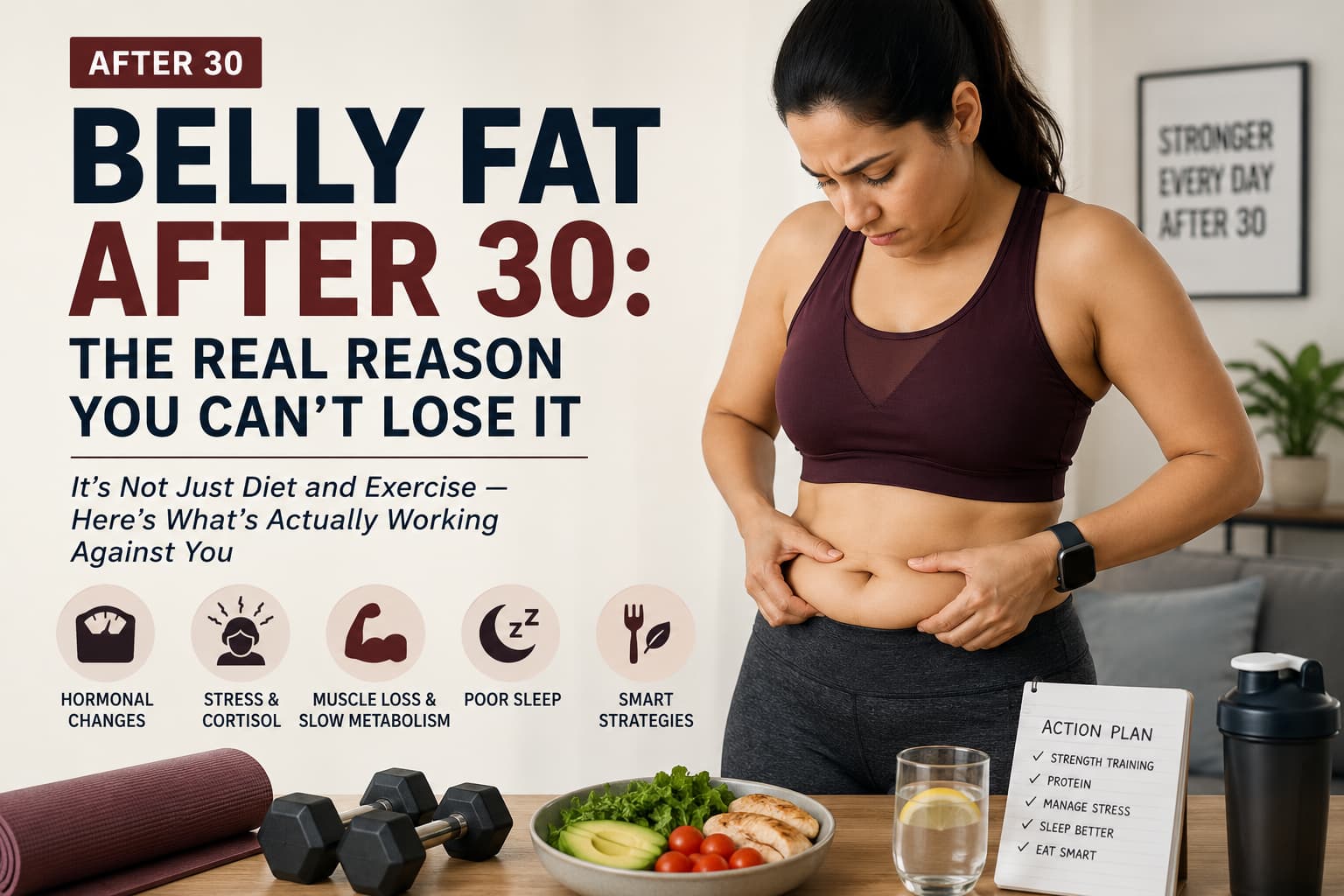
Diet and exercise not working on belly fat after 30? Discover the hormonal reasons why, and what actually helps you lose it.
Introduction
You’re eating better than you did in your 20s. You’re working out consistently, maybe even more than before. And yet that stubborn layer around your midsection barely budges — sometimes it seems to grow despite your best efforts.
If this sounds familiar, you’re not imagining it, and you’re definitely not doing everything wrong. Belly fat after 30 behaves differently than it did in your 20s, because the internal environment driving it has quietly changed: hormones shift, metabolism slows, and stress accumulates in ways that specifically favor fat storage around the abdomen.
This guide goes past the generic “eat less, move more” advice to explain the actual hormonal and metabolic reasons belly fat becomes so stubborn after 30 — and the specific strategies that address those root causes instead of fighting against them.
| Key Takeaways |
- Belly fat after 30 is driven heavily by hormonal shifts — insulin resistance, cortisol, and declining sex hormones — not just calories in versus calories out.
- Visceral fat (the deep abdominal type) is metabolically active and responds differently to diet and exercise than fat elsewhere on the body.
- Chronic stress and poor sleep can stall belly fat loss even when diet and exercise are otherwise on point.
- Muscle loss after 30 slows resting metabolism, meaning the same eating habits that worked at 25 may no longer maintain the same weight.
- Strength training and protein intake become more important after 30 specifically because they counteract age-related muscle loss.
- Addressing the underlying hormonal drivers — not just cutting calories further — is usually what finally moves stubborn belly fat.
1. Why Diet and Exercise Alone Aren’t Always Enough After 30
The standard advice — eat less, exercise more — isn’t wrong, but it’s incomplete. It assumes your body responds to calorie changes the same way it did a decade ago. After 30, several internal shifts change that equation.
Your body isn’t working against you out of nowhere. It’s responding to a different hormonal and metabolic environment than it had in your 20s, which is exactly why the same approach that used to work can stop producing results.
2. The Real Reason: Hormonal Shifts Driving Belly Fat
This is the part most generic advice skips entirely. Several hormones shift measurably after 30, and nearly all of them push fat storage toward the abdomen specifically:
| Hormone | Why It Blocks Belly Fat Loss |
| Insulin Resistance | Cells stop responding well to insulin, so more sugar gets converted and stored as visceral (belly) fat instead of used for energy. |
| Cortisol (Stress Hormone) | Chronic stress keeps cortisol elevated, which specifically signals the body to store fat around the abdomen. |
| Declining Estrogen / Testosterone | Falling sex hormones after 30 shift fat storage patterns toward the midsection in both women and men. |
| Slowing Thyroid Function | A gradually slowing thyroid lowers resting metabolic rate, making calorie balance harder to maintain even with no diet changes. |
This is why two people eating identical diets can store fat completely differently — their hormonal environment, not just their calorie intake, determines where that fat ends up.
3. Visceral Fat vs. Subcutaneous Fat: Why Location Matters
Subcutaneous Fat
This is the fat you can pinch — it sits just under the skin and, while not ideal in excess, carries lower metabolic risk.
Visceral Fat
This deeper fat surrounds your organs and is metabolically active, releasing inflammatory compounds that worsen insulin resistance — creating a cycle that makes it especially resistant to typical dieting.
Belly fat after 30 tends to shift toward this visceral type, which partly explains why it feels harder to lose than fat elsewhere on the body, even with the same effort that worked in the past.
4. The Cortisol-Stress Connection
Your 30s often bring peak career demands, financial pressure, and family responsibilities — a recipe for chronically elevated cortisol. Unlike short bursts of stress, sustained high cortisol specifically signals your body to store more fat around the midsection as a survival mechanism.
This means someone under constant stress can do everything else right — clean diet, regular workouts — and still struggle to lose belly fat until the underlying stress load is addressed.
| Worth Knowing Cutting calories further while already under high stress can backfire, since it adds another stressor that keeps cortisol elevated. Addressing stress directly is sometimes the missing piece. |
5. Muscle Loss and Your Slowing Metabolism
Starting around 30, adults lose roughly 3–8% of muscle mass per decade if strength training isn’t part of the routine. Since muscle burns more calories at rest than fat does, this quiet loss steadily lowers your resting metabolic rate.
The practical effect: the same diet and cardio routine that maintained your weight at 25 may not be enough at 35, not because you’re doing anything wrong, but because your baseline calorie needs have genuinely changed.
6. Sleep’s Hidden Role in Belly Fat Storage
Poor sleep disrupts two key appetite hormones — ghrelin and leptin — increasing hunger and cravings for high-calorie food the next day. It also raises cortisol, compounding the stress-driven fat storage described earlier.
Adults consistently sleeping under 6 hours a night show measurably higher rates of abdominal fat gain in research, independent of diet quality — making sleep one of the most overlooked levers in this entire equation.
7. What Actually Works: Evidence-Based Strategies
Prioritize Strength Training
Resistance training two to three times a week directly counters age-related muscle loss and improves insulin sensitivity, addressing two root causes at once.
Eat Enough Protein
Aiming for roughly 0.7–1 gram of protein per pound of body weight supports muscle maintenance and keeps you fuller, making calorie management easier without extreme restriction.
Manage Stress Actively
Even 10 minutes of daily deep breathing, a short walk, or a consistent wind-down routine can measurably lower cortisol over time.
Protect 7+ Hours of Sleep
Treating sleep as a non-negotiable, not an afterthought, directly supports the hormones that regulate appetite and fat storage.
Moderate Refined Carbs and Alcohol
Both spike insulin and are metabolized in ways that particularly favor visceral fat storage — moderation here tends to move the needle faster than cutting fat or protein.
8. Common Mistakes People Make Trying to Lose Belly Fat
- Doing endless ab exercises expecting spot reduction, which isn’t supported by research — you can’t target fat loss to one area.
- Cutting calories too aggressively, which raises cortisol and can worsen the very hormonal pattern driving belly fat storage.
- Skipping strength training in favor of cardio only, missing the muscle-preserving benefit that keeps metabolism higher.
- Ignoring sleep and stress entirely, focusing only on food and exercise while two major hormonal levers go unaddressed.
- Expecting fast results, when hormonally-driven belly fat typically takes 8–12 weeks of consistent change to show visible movement.
9. Supplements and Tools That Can Help
No supplement replaces the fundamentals above, but a few have research supporting a role in the broader picture:
- Magnesium: Supports better sleep quality and healthy cortisol regulation, both directly relevant to belly fat.
- Omega-3 fatty acids: Associated with modest reductions in visceral fat and improved insulin sensitivity in several studies.
- Protein powder: A practical way to hit daily protein targets that support muscle maintenance, especially on busier days.
- A simple fitness tracker or smartwatch: Useful for keeping sleep and activity consistent — two of the biggest levers covered in this guide — without needing to overhaul your entire routine at once.
10. Frequently Asked Questions
| Q: Why is belly fat so hard to lose after 30? A: Hormonal shifts — including rising insulin resistance, elevated cortisol, and declining estrogen or testosterone — specifically favor abdominal fat storage after 30, making it more stubborn than fat elsewhere on the body. |
| Q: Can you target belly fat with exercise alone? A: No — spot reduction isn’t supported by research. Overall fat loss through a combination of strength training, diet, sleep, and stress management reduces belly fat as part of total body fat loss. |
| Q: Does stress really cause belly fat? A: Yes — chronically elevated cortisol from ongoing stress specifically signals the body to store more fat around the abdomen, which is why stress management can be as important as diet. |
| Q: How long does it take to lose belly fat after 30? A: Most people see visible changes within 8–12 weeks of consistent strength training, adequate protein, better sleep, and stress management, though individual timelines vary. |
| Q: Does menopause or low testosterone affect belly fat? A: Yes — declining estrogen in women and declining testosterone in men both shift fat storage patterns toward the midsection, which is part of why belly fat often increases through the 30s and 40s. |
11. Your Action Plan: Start Today
- Add two strength training sessions this week, even 20-minute sessions targeting major muscle groups.
- Track your protein intake for three days to see how close you are to 0.7–1 gram per pound of body weight.
- Pick one stress-reduction habit — a short walk, breathing exercise, or wind-down routine — and do it daily for a week.
- Set a consistent bedtime that allows for at least 7 hours of sleep, treating it as seriously as your workouts.
- Reduce refined carbs and alcohol on at least 5 days this week, without eliminating them completely.
Conclusion
Stubborn belly fat after 30 isn’t a sign that you’re failing — it’s a sign that your body’s hormonal environment has changed, and the old playbook needs an update. Once you address the real drivers — insulin resistance, cortisol, muscle loss, and sleep — the same effort you’ve already been putting in starts producing very different results.
Pick one lever from this guide and commit to it for the next two weeks. Your midsection responds to consistency far more than intensity, and consistency is something you’re fully capable of.
| Medical Disclaimer This article is for informational purposes only and is not a substitute for professional medical advice, diagnosis, or treatment. Always consult a qualified healthcare provider before making changes to your diet, exercise routine, supplements, or medication, especially if you have an existing health condition. |


