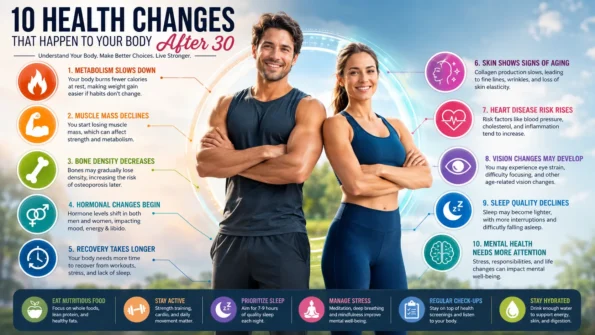
10 Health Changes That Happen to Your Body After 30: What Every Adult Should Know
Introduction For many people, the age of 30 marks a meaningful transition from the carefree energy of young adulthood into a more mature, responsibility-laden stage of life. While aging is an inevitable natural process, the body begins undergoing several significant physiological shifts during this decade that can affect energy levels, weight management, physical performance, mental health, and overall quality of life. These changes do not happen all at once, and they are rarely dramatic in the short term. Instead, they accumulate gradually — sometimes going unnoticed for years — until a person finds that they can no longer eat the same way they did at 22 without gaining weight, or that they feel soreness after workouts they would have shrugged off a decade earlier. These experiences are not imagined; they reflect real, measurable biological shifts. The good news is that most of these changes are manageable. With the right lifestyle habits — including balanced nutrition, consistent exercise, quality sleep, and preventive healthcare — you can maintain excellent health and energy well into your 40s, 50s, and beyond. In this comprehensive guide, we will explore the 10 most important health changes that happen to your body after 30, explain why they occur, and provide practical, evidence-based strategies to help you stay healthy and active for decades to come. 1. Your Metabolism Begins to Slow Down What Happens? One of the most commonly noticed health changes after 30 is a gradual decrease in metabolic rate — the speed at which your body burns calories to fuel basic functions like breathing, circulation, and cell repair. In your twenties, a naturally higher metabolism means your body burns through energy relatively quickly even at rest. As you enter your thirties, however, this baseline calorie-burning slows down, and the effects can be surprisingly significant over time. This slowdown is not dramatic from one day to the next, but its cumulative impact over months and years becomes very real. Many people find that they gain weight more easily, feel less energetic throughout the day, and struggle to shed extra pounds despite not changing their diet or exercise habits. The body is simply operating at a lower metabolic intensity than it once did. Why It Happens Several interconnected factors drive this slowdown. The most significant is the gradual loss of lean muscle mass — muscle tissue is metabolically active and burns more calories at rest than fat tissue does. As muscle mass decreases, fewer calories are burned passively throughout the day. Hormonal changes also play a role: testosterone and estrogen, both of which support muscle maintenance and metabolic efficiency, begin to decline after 30. Additionally, many adults become less physically active as professional and family responsibilities grow, and sedentary behavior further suppresses metabolism. The result is a compound effect — less muscle, less activity, and less hormonal support all working together to slow calorie burning. How to Manage It The most effective strategy to counter a slowing metabolism is strength training. Building and preserving lean muscle through resistance exercises — such as weight lifting, bodyweight workouts, or resistance band training — directly increases your resting metabolic rate, helping your body burn more calories even when you are not exercising. Aim for at least two to three strength sessions per week. Beyond formal workouts, increasing your overall daily movement is highly effective. Simple habits like walking more frequently, taking stairs instead of elevators, using a standing desk, or even pacing during phone calls can meaningfully boost your total daily energy expenditure. These small choices add up significantly over weeks and months. Nutrition also plays a crucial role. Prioritizing protein at every meal helps preserve muscle mass, supports feelings of fullness, and requires more energy to digest than carbohydrates or fats — a property known as the thermic effect of food. Whole, unprocessed foods support a healthier metabolic environment compared to highly processed, calorie-dense alternatives. 2. Muscle Mass Starts Declining What Happens? After age 30, adults who are not actively engaged in resistance training may begin to lose approximately 3 to 8 percent of their muscle mass per decade. This gradual process — medically known as sarcopenia — is one of the most consequential age-related changes because muscle plays a vital role in almost every aspect of physical health and independence. The decline is typically subtle at first. You might notice slightly reduced strength when performing tasks that once felt easy, or greater fatigue after physical activity. Over time, however, the loss of muscle mass has deeper implications: it contributes to slower metabolism, weakened joints, impaired balance, and ultimately, a reduced ability to perform daily activities independently as you age. Why Muscle Matters Muscle tissue is far more than just the engine behind physical strength. It serves as the body’s primary calorie-burning engine, helps protect and stabilize joints against injury, plays a central role in maintaining healthy blood sugar levels by absorbing glucose from the bloodstream, and supports cardiovascular health through regular physical activity. Preserving muscle mass throughout your thirties and forties is one of the most powerful investments you can make in your long-term quality of life. Prevention Strategies Engaging in resistance training two to four times per week is the gold standard for preventing sarcopenia. Compound movements that work multiple muscle groups simultaneously — such as squats, deadlifts, push-ups, rows, and lunges — are particularly effective. These exercises not only build muscle but also improve coordination, bone density, and joint stability. Nutrition is equally important. Consuming adequate protein — ideally distributed across all meals of the day rather than concentrated in a single sitting — provides the amino acids your muscles need for repair and growth. Most adults benefit from aiming for approximately 1.2 to 1.6 grams of protein per kilogram of body weight daily, though individual needs vary. Foods like eggs, lean meats, fish, dairy, legumes, and tofu are excellent sources. 3. Bone Density Gradually Decreases What Happens? The human skeleton reaches its peak bone mass around the age of 30. After this point, the balance